
As we enter new and different stages of our lives, we must learn to understand what is expected of us and how to meet those expectations. As someone who is in their second year of university, preparing for a future in the workplace, I am not only trying to learn the information that will help me get and retain a job, but I am also trying to learn what society expects of me in this new age of technology. You could say that the newest generation of graduates entering the workplace have spent most of their lives dependent on technology. As Figure 1 depicts, younger generations daily use of the internet has grown the most rapidly compared to other generations (Carr, Dangerfield, Harris, Matkov and Pettit). But we also are the generation that is most in tune with what technology has to offer. It is important that we understand how much we influence the spread of technology and how much it influences us.
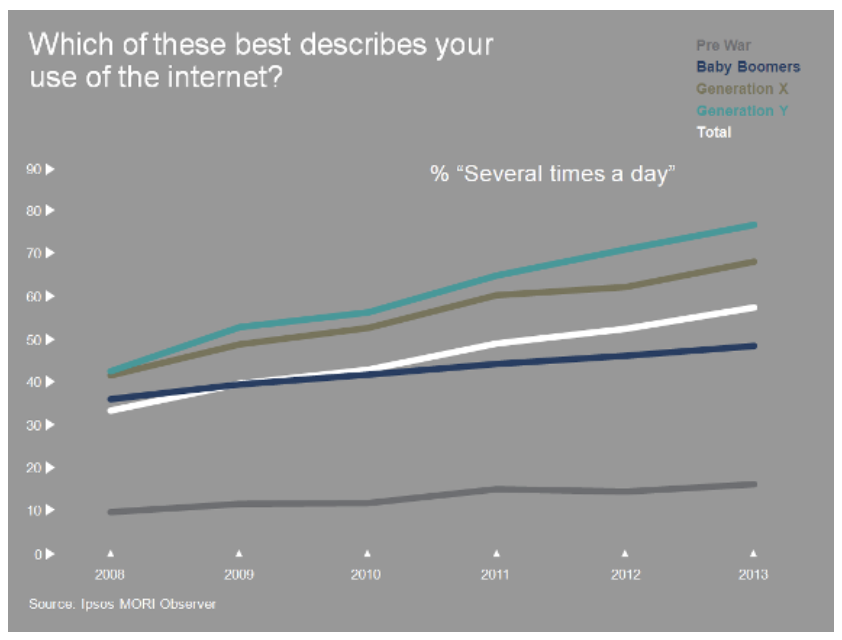
Figure 1. Internet Usage by Generation. Reprinted from Ipsos MORI by H. Carr, P. Dangerfield, K. Harris, L. Matkov and E. Pettit, Retrieved from http://www.ipsos-mori-generations.com/internet-and-technology-use.
As I study computer information systems at school, I am not only learning what is required of the subject but also how much a future career in the field will make me a better knowledge worker. The field of information technology employees millions of workers who were most likely trained to deal with developing technological advancements and innovation for the rest of society. Therefore, a company who is trying to create and distribute innovation into the global market should understand the theory of innovation of diffusion. The concept centers around how new ideas spread between people and how quickly, or slowly, that can happen. This concept is important to a company like Apple, or any developer of new innovations. There are 4 elements, or attributes, that a company focuses on to ensure that diffusion happens more rapidly.
- The innovation itself, people must know about your product for it to spread.
- Communication channels. Most people hear about products and new technological advancements through media or friends (“Diffusion and Adoption of Innovations”, n.d.).
- Time. First being the time it takes for an individual to form an attitude about a certain innovation. Secondly, whether the individual is usually one of the first or last to adopt the innovation. Lastly, the rate at which it will be adopted by others in the society (“Diffusion and Adoption of Innovations”, n.d.).
- The social system. This is about who makes up society and whether or not the individuals are part of a group where diffusion happens quickly and can propel the group to a state of critical mass.
There are also the different types of people in society that an innovator must understand how to deal with. As shown in Figure 2, there are five groups who categorize society for how quickly they adopt an innovation or new technology into their lives. The critical mass point as mentioned prior, falls between the early and late majority which means that innovation “explodes” into everyday use by people.
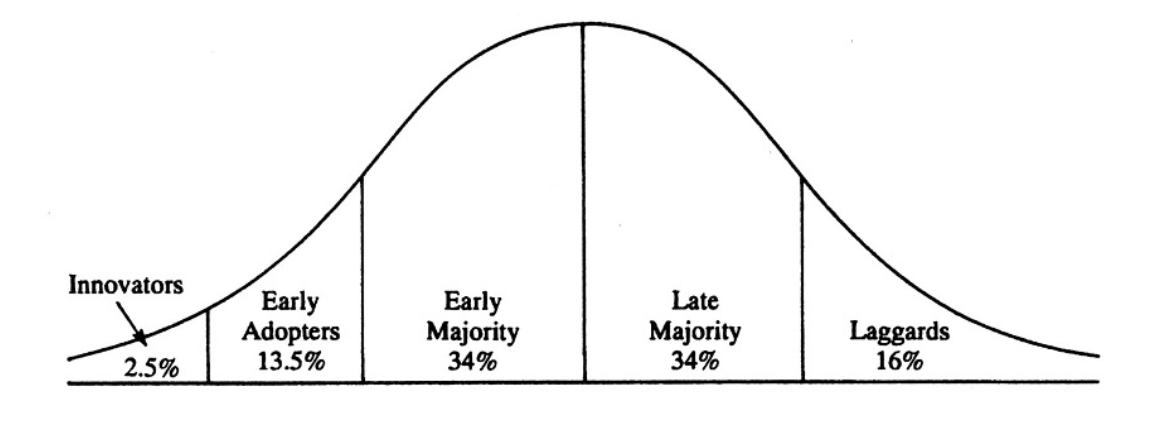
Figure 2. Diffusion of Innovations Theory- Adoption and Diffusion. Reprinted from AgriFuture Australia by G. Beever, Retrieved from https://extensionaus.com.au/extension-practice/diffusion-of-innovations-theory-adoption-and-diffusion/
I hope that when I begin working for an IT company, I can offer my insight and knowledge for how to not only develop and advance technology but also how advantageous these theories are to marketing tactics. For instance, the concept of heterophily and homophily. In an environment like an IT company, you would probably expect that culture to foster more of a heterophily group of people since they can bounce different ideas off one another. But in contrast, a group of homophily people cause diffusion to happen more rapidly because they share the same beliefs and often influence one another with their opinions (Ramazi, Riehl and Cao, 2018). So, I believe it is important that I, and all other aspiring workers, know how relevant it is to learn this information now and how much better off you’ll be in the future as someone who can bring this type of knowledge to the table of the company you end up working for.
It is important to know how innovation spreads amongst us but even more so, how everyone is more a part of it than they realize. Everyone, with or without knowing it, can place themselves on the scale of technological determinism. I place myself on the scale as a socio-culturalist, someone who believes that society is shaping technology, versus a technological determinist, who believes that society is shaped by technology (Flew, 2014). I think most of us are conscious of how much our lives are consumed by technology but that doesn’t mean we are influenced so much by technology that we aren’t capable of being the sole innovators of our time. I hope that whatever I may end up doing after university, if it’s in the field of information technology or not, that I can create new innovations that help the rest of the world.
References
Beever, G. (2016). Diffusion of Innovations Theory- Adoption and Diffusion. Retrieved February 10, 2019 from https://extensionaus.com.au/extension-practice/diffusion-of-innovations-theory-adoption-and-diffusion/
Carr, H. Dangerfield, P. Harris, K. Matkov, L. & Pettit, E. (n.d) Internet and Technology Use. Retrieved February 10, 2019 from http://www.ipsos-mori-generations.com/internet-and-technology-use.
Corporate Finance Institute. (2019). Knowledge Workers – Who They Are and What They Do. Retrieved February 10, 2019 from https://corporatefinanceinstitute.com/resources/knowledge/other/knowledge-workers/
Critical mass (sociodynamics). (2018). Retrieved from https://en.wikipedia.org/wiki/Critical_mass_(sociodynamics)
“Diffusion and Adoption of Innovations.” (n.d.) Encyclopedia of Public Health. Retrieved February 10, 2019 from https://www.encyclopedia.com/education/encyclopedias-almanacs-transcripts-and-maps/diffusion-and-adoption-innovations
Flew, T. (2014). New Media. Australia: Oxford University Press
Hobar, G. [Username]. 2014, November 21. Technological Determinism Explained. [https://youtu.be/y_sEWPSNwg4]. Retrieved from https://www.youtube.com/watch?v=y_sEWPSNwg4
Ipsos MORI. Internet Usage by Generation. Retrieved from http://www.ipsos-mori-generations.com/internet-and-technology-use.
Jenks, B. [Rare]. 2015, April 2. Diffusion of Innovation Theory: The Adoption Curve. [https://youtu.be/9QnfWhtujPA]. Retrieved from https://www.youtube.com/watch?v=9QnfWhtujPA
Knowledge Workers. (2019). Retrieved February 10, 2019, from https://corporatefinanceinstitute.com/resources/knowledge/other/knowledge-workers/
Ramazi, P., Riehl, J. and Cao, M. (2018). Homophily, heterophily and the diversity of messages among decision-making individuals. Royal Society Open Science, 5(4), p.180027. https://royalsocietypublishing.org/doi/full/10.1098/rsos.180027
Szczebra, R. (2019). 20 Great Technology Quotes To Inspire, Amaze, And Amuse. Forbes.com. Retrieved February 10, 2019 from https://www.forbes.com/sites/robertszczerba/2015/02/09/20-great-technology-quotes-to-inspire-amaze-and-amuse/#50e0518616a6
 Digital Dynasty